
What I learned living in the woods for three years
and by 'the woods', I mean the remnants of civilisation - repurposing waste and scrap into some kind of Mad Max anarchist utopia...
I embarked on my journey into the woods with almost nothing. In the weeks prior I sold my laptop and gave away my possessions except for a tent, sleeping bag and a couple bags of clothes. In the weeks following I realised these clothes were nothing more than useless nylon remnants of urban life. This was not ‘dropping out’. I was taking a stand. Charged by the Occupy movement and armed with naivety, arrogance and an introductory permaculture course, I was convinced that the only rational approach to unfolding ecological, social and economic crises was to head back to the land. The year was 2012.
We were a small and ragged group that varied in size of between 6 and 60 over the three years I lived at Yorkley Court Community Farm - a squatted farm in the Forest of Dean, England. The ownership of the land was unknown; a land agent, a local businessman and the descendants of the last known owners all potential claimants. At the invitation of a handful of locals who knew each other through Transition Towns meetings, our group boldly set about to ascertain the land’s true owners and bring the farm into abundance for ‘the community’ - by occupying the site. While there is much I could write about Yorkley Court, the characters, my friends and the years of twisting plot narrative, I won’t. Instead I want to write about the ways in which this experience changed the way I see the world. As such I will write primarily in the first person. Except when I don’t.
Our ragged group ‘broke the squat’ in the middle of the night - a customary time for urban squatters to enter a building and a completely unnecessary caution in the depths of the Forest of Dean. Arriving on a boggy piece of land with basically no money, tools, equipment or resources and just a handful of local connections felt like the most sane and necessary action possible. It was abundantly clear to me that humanity was fucked. Our little group was ahead of the game. Apocalypse was imminent. The plan was to learn the skills that everyone else would so urgently need when the industrial capitalist structures around us fell apart. We would live off the remnants of civilisation, repurposing the waste and scrap into some kind of Mad Max anarchist utopia. Obviously.
For the first months my home in utopia was a wet tent. The summer of 2012 was the most torrential I have ever experienced in the UK. It rained all summer. Everything was mud. Without established gardens and farm systems food was scarce. It was a four mile walk to town, where there was a supermarket with bins we could raid. Locals who believed in our cause donated food to us. And we ate nettles. Lots of nettles.
Within the first year I had built myself a dwelling. It was a geodesic dome made from hazel poles I harvested myself. It was insulated with duvets that came from a college at term end. The side panel of a lorry truck made the outer cover. The platform was built on old tyres stacked to create a level with old scaffolding boards fixed on top. Heat came from a burner fashioned from an old gas bottle, cut and fixed with a door and flu - all materials found in a skip. Scrap carpet insulated the floor. Scrap fabric decorated the walls. My dome sweet dome had a 5m diameter.
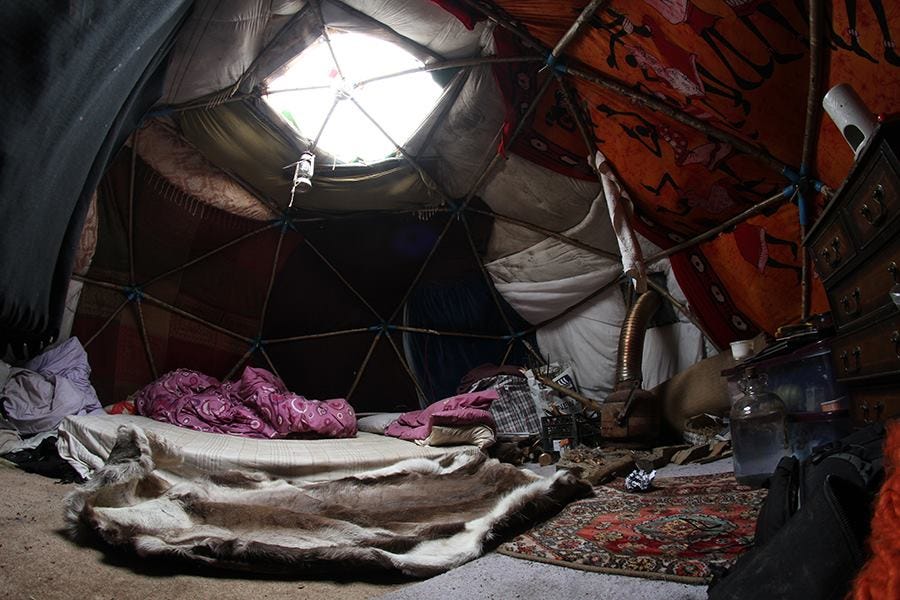
Life took on a daily rhythm. Everyday water was collected from the spring. Everyday firewood was cut. Food was gathered and harvested and chopped and cooked and preserved. On average I lit 3-4 fires a day. Fire became a deeply intimate ally. To this day if a fire is blowing smoke in my face I’ll simply ask the smoke to move. It always does. Always. Keeping on top of the preparations was key. A period of low motivation had vicious cumulative effects. The simple act of doing the dishes required collecting water, collecting wood, chopping wood, lighting the fire, heating the water - a task made manageable if the water stores were full, the firewood prepared.
The summer months stretched on until, seemingly suddenly, the days began to draw in. One week I was going to bed in the light, the next I was having to down tools because it was too dark. Head torches and candles lit the evenings. Life became smaller. By November it was too dark to cook dinner at 5pm. As the sun retreated for the winter, so did I. I shed my summer expanse like a tree and retreated into the darker depths. Long hours were spent by the fire and in return the fire shared her wisdom. Sparks of a new way of knowing were kindled. Despite the cold, much of life was spent outside. Night vision became a new sense. The moon and the stars became characters in my life. Every evening Orian would nod as he aimed his arrow at the eye of the bull. The twins, the crab and the lion would tell stories as they traversed the night sky. Gravity took on a depth of meaning as I pondered why the planets, moon and sun all followed the celestial line through the sky. Over time the night sky came to tell me what to do in the garden the following day.
I wish I could say that deep imagination was a place that I was able to wander freely, but in reality I fumbled in and out of this space. In hindsight I can see my soul was hurting too much and my ego too demanding for deep imagination to really take hold. I was dominated by productivity myths linking my self worth to how much I was achieving. I was fighting daily, and failing, to keep at bay a darkness I couldn’t understand. I was in deep conflict with myself and thus struggled to hold my attention in the thin space between my own consciousness and the consciousness of the world around me. I was not yet ready for the depths, but I was ready for the first hints of healing that could be found through deep engagement with the natural world.
One morning in April the cold was well and truly subsiding to make space for spring. The sun shone through the dusty haze of my dome window and I was awakened by a curious sound - a dense, roaring hum. Peering out the hanging flap of tarp I called the door, my neighbour the hawthorn was basking in the sun adorned in the radiant, blooming finery of white flowers. This majestic display had called to attention a boisterous showing of bees who had all but engulfed her. Together they roared that the Spirit of Spring had awoken, and she took my breath away. As I stared, overcome with joy and adoration, I began to sense that my presence was not merely that of a passive observer. I, too, was part of this spectacle, participating in its creation and realisation. The bees and the tree were celebrating my presence as I was celebrating theirs. My humanness was not a virus invading the landscape, quite the opposite. I belonged to these beings and they belonged to me. We were each others. The bees, the land, the hawthorn and me - in relationship, cohabitation, collaboration. We had been missing each other. Where had I been for so long?
I had no tools to explain this feeling, but somehow it was more real than any rational explanation I could muster. My mind wanted to disregard the experience as emotion, longing, hope or imagination. And yet another part of me was deeply moved. Intuition took hold of this experience and forced my rational mind to stand aside. For a long time I felt like I couldn’t share this experience. It did not align with the self image of my engineering education. Eventually, as I opened to talking about it, it became more real. Others would share their experiences and together we validated each other's perspective and insights. As experiences like this began to normalise other ways of knowing began to open. I began to allow another reality to coexist in my mind - a reality that gave sentience and agency to the more-than-human world. I am convinced that opening to such ways of knowing is the most crucial step to unpacking the oppressive systems that live inside us and co-manifest this reality everyday.
Without cultural traditions to draw on, our little anarchist utopia was thrust into inventing our governance and processes as we went. And as novices we didn’t know where to start or what to look out for. We boldly went about dismantling the oppressive systems that we felt had kept us contained our entire lives. One person declared that they had left conventional society because they wanted to not have meetings, and so for a while we attempted non-hierarchical governance without meetings, which is obviously (in hindsight) utterly hilarious. Instead of group meetings, individuals would engage one to one to work things out. Into each interpersonal interaction we carried our demons and rifts soon formed. The result, within weeks, was a power structure I like to refer to as ‘the mob’. Under the wrath of the mob a number of people felt bullied out of the community. The mob came for me at one point, because I’d started a local food distribution project. More purist members of the community felt that selling food for money was not aligned with our group’s (unspoken) vision, and that I should stop or leave.
If I’d had somewhere else to go I would have left, but mystery had other plans for me. One evening under the light of the full moon, in pain and tears wandering back to my dome, the sound of a nightingale echoed through the air. I had never heard a nightingale sing before. It stopped me in my tracks. The resonance of the sound reverberating down the valley engulfed me in a sense of power and beauty. Again, in this moment, the sense of belonging overpowered me. I didn’t leave. Instead, I participated in humbling and transformative processes of conflict resolution and collective visioning. I attribute much of my skill in facilitation and non-hierarchical organising to sticking it out through these first, tentative experiences of transpersonal healing. I don’t believe that the nightingale was speaking to me that night. I believe that by allowing my imagination to hold the possibility that the nightingale spoke with me I found a deeper courage than I’d known to be possible.
It was some years later that I left Yorkley Court Community Farm. Why I left is a story for a future post; a multitude of reasons, not least thathe universe had other plans for me and threw a boulder at me to make sure I was abundantly clear of them. Not so many months after I left the local businessman attempting a land grab of the farm was successful. Bailiffs burned my dome sweet dome to the ground.
Most of the others that lived in this community have continued to live in this way, on land projects dotted about the UK. I feel like an imposter writing about the 3 years I spent when now most of these folks will have been doing this over a decade and so many others across land movements for much longer. I often wonder if I will go back to this way of living. For now I have allowed my life to take another direction, in part due to fear. Without the money to buy land I’ve been afraid of the lack of security, unable to trust that community and land will nurture me. Diving deeper and deeper into the fringes of industrial capitalist society requires enormous leaps of faith. Dozens of them. Each dive takes courage and trust. Each dive is difficult. And yet somehow together so many of us are figuring out these leaps day by day, determined to evolve and terrified of change. For me, the knowledge that it is a scary journey for all of us gives me strength to continue to take these leaps. We are a culture building the courage to leave the nest. And so here we find ourselves on this journey endlessly struggling on the precipice, attempting to take off.
Thanks for being with me on this journey. It means more to me than you know.